Product Description
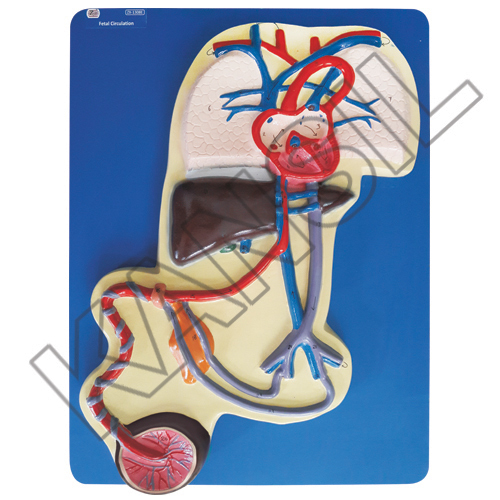
The Fetal Circulation Model utilizes 3 shunts.These are little entries that immediate blood that should be oxygenated.The reason for these shunts is to sidestep the lungs and liver. That is on the grounds that these organs won't work completely until after birth. The shunt that sidesteps the lungs is known as the foramen ovale. This shunt moves blood from the right chamber of the heart to the left chamber. The ductus arteriosus moves blood from the pneumonic vein to the aorta.Oxygen and supplements from the mother's blood are sent across the placenta to the baby. The advanced blood courses through the umbilical rope to the liver and parts into 3 branches. The blood then, at that point, arrives at the substandard vena cava. This is a significant vein associated with the heart. The majority of this blood is sent through the ductus venosus. This is likewise a shunt that allows exceptionally oxygenated blood to sidestep the liver to the substandard vena cava and afterward to the right chamber of the heart. A modest quantity of this blood goes directly to the liver to give it the oxygen and supplements it needs.
Frequently Asked Questions:
1) What are the steps of fetal circulation?
Blood enters the right atrium
Blood then passes into the left ventricle
From the aorta, blood is sent to the heart muscle itself and to the brain and arms
This less oxygenated blood is pumped from the right ventricle into the pulmonary artery
2) What is meant by fetal circulation?
The fetal circulation system is unmistakably not quite the same as grown-up dissemination. This unpredictable framework permits the embryo to get oxygenated blood and supplements from the placenta. It is included the veins in the placenta and the umbilical line, which contains two umbilical conduits and one umbilical vein.
3) Is fetal circulation parallel or series?
In the fetal circulation, the placental, systemic, and pulmonary circulations are all in parallel and subject to the same blood pressure.
4) What is the difference between fetal and maternal circulation?
The in-flowing maternal arterial blood pushes deoxygenated blood into the endometrial and then uterine veins back to the maternal circulation.The fetal-placental circulation allows the umbilical arteries to carry deoxygenated and nutrient-depleted fetal blood from the fetus to the villous core fetal vessels.
Precisely Crafted for Medical EducationThe Fetal Circulation Model is engineered for accurate and easy-to-understand demonstrations in medical studies. Its life-size proportions help users visualize key elements of fetal circulation, making it an essential aid in classrooms and clinical settings. The model is crafted from durable, hand-painted PVC, ensuring long-lasting use and anatomical precision. Detachable components allow for hands-on learning, fostering an engaging educational environment.
Effortless Care and StorageMaintaining the Fetal Circulation Model is simplejust wipe with a damp cloth to keep it clean. No assembly is required, and the model arrives securely pre-mounted. To preserve its hand-painted finish and vibrant details, store the model in a dry place and avoid direct sunlight. Its sturdy plastic base makes the model stable during demonstrations, and its lightweight design allows for easy transport and storage.
FAQs of Fetal Circulation Model:
Q: How should the Fetal Circulation Model be cleaned and maintained?
A: To clean the model, gently wipe all surfaces with a damp cloth. Do not use harsh chemicals or submerge any parts. Store the model in a dry place and avoid direct sunlight to preserve its hand-painted finish and anatomical details.
Q: What components can be removed from the Fetal Circulation Model for close study?
A: The major anatomical partssuch as arteries, veins, umbilical cord, and placentaare detachable, allowing students and professionals to closely examine key structures and better understand fetal circulation.
Q: Where can this model be effectively used for educational purposes?
A: The Fetal Circulation Model is designed for use in medical colleges, nursing schools, hospitals, and exam training centers. It is ideal for classrooms, labs, and demonstration sessions that require visualization of fetal blood flow.
Q: When is this model most beneficial in a teaching or learning environment?
A: This model is most beneficial during lectures, hands-on demonstrations, and practical examinations where comprehensive understanding of fetal circulation is required. It serves as a vital aid for both instructors and students.
Q: What is included in the package when purchasing the Fetal Circulation Model?
A: Each package contains one Fetal Circulation Model and a user manual with detailed instructions for use and care. The model comes pre-mounted on its sturdy base and requires no assembly.
Q: How does the Fetal Circulation Model enhance medical education?
A: By providing visual and tactile access to detailed anatomical features, the model helps users understand the mechanics of fetal blood flow. Its removable parts and clear labeling in English facilitate hands-on study and effective teaching.

 English
 Spanish
 French
 German
 Italian
 Chinese (Simplified)
 Japanese
 Korean
 Arabic
 Portuguese











 Send Inquiry